
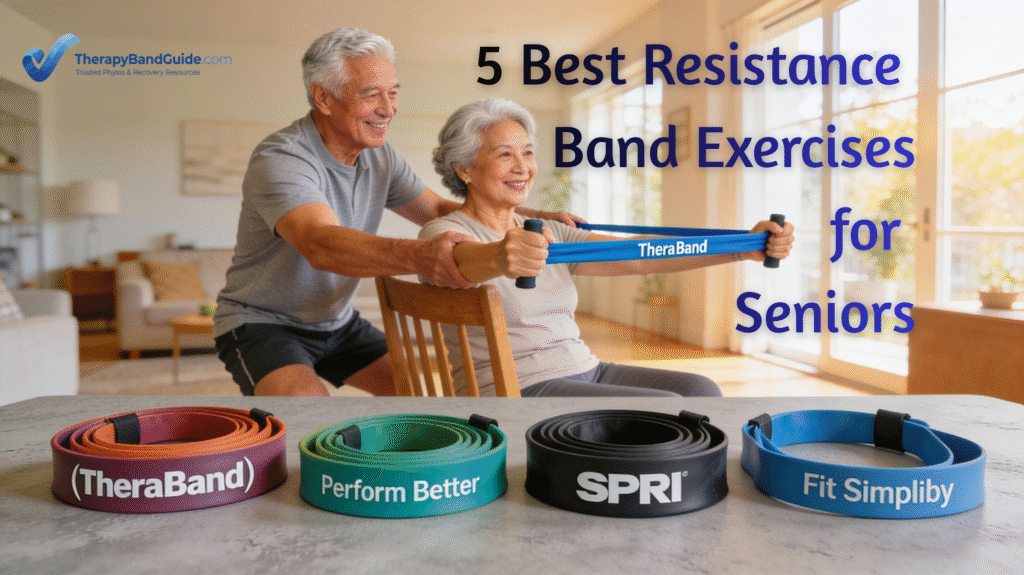
It is completely normal to feel a little hesitant about starting a new exercise routine. You might worry about your balance, fear aggravating an old injury, or perhaps you just think, “I’m too old to start now.”
I want to reassure you right away: it is never too late to reclaim your strength.
Resistance bands are widely considered the gold standard for senior fitness at home. Unlike heavy metal dumbbells that can be dropped or machines that force your body into awkward positions, bands are gentle on your joints. They allow you to move naturally while building the muscle you need for essential daily tasks—like standing up from your favorite chair, carrying a bag of groceries, or reaching for a cup on the top shelf.
This guide is designed specifically for safe workouts for elderly adults. We focus on gentle progression, safety, and maintaining your independence. By starting with these simple movements, you are taking a massive step toward better health.
Disclosure: As an Amazon Associate I earn from qualifying purchases. This post contains affiliate links.
Critical “Safety First” Checklist
Before you pick up a band, we need to set the stage for success. Safety isn’t just a suggestion; it is the foundation of effective resistance band exercises for seniors. Please review this checklist before every session.
- Get Your Doctor’s “Green Light”: Always consult your physician before starting any new fitness program, especially if you have a history of heart conditions, recent surgeries, or balance issues.
- The “Pain vs. Discomfort” Rule: Exercise should feel like work. You might feel a burning sensation in your muscles—that is good! However, if you feel sharp, shooting pain in your joints, stop immediately.
- Secure Your Environment: Ensure you are exercising on a non-slip surface. Remove throw rugs that could cause trips.
- Use a Stable Chair: For most of these exercises, you will need a sturdy chair without wheels (like a dining chair). If you need extra stability, place the chair against a wall so it cannot slide backward.
- Inspect Your Bands: Check your bands for small tears or holes before every use. A snapped band can sting!
Recommendation for Getting Started:
If you don’t have equipment yet, I strongly suggest starting with a set designed for seniors. A dedicated “Seated Resistance Band Set” often includes comfortable handles and lighter tension levels perfect for beginners.Perfect Senior Starter Band Set
The 5 Essential Exercises
These movements are designed to target the specific muscles that support your daily life. We focus on strength training after 60 that supports posture, walking, and gripping.
1. Seated Row for Better Posture
Purpose/Benefit:
We often spend a lot of time sitting, which can lead to a rounded upper back. This exercise strengthens the muscles between your shoulder blades. It combats that “hunched” posture and makes it easier to keep your chest up and breathing open.
Equipment Needed:
Light Resistance Band (Yellow/Red) with handles, or a long flat band.
Step-by-Step Instructions:
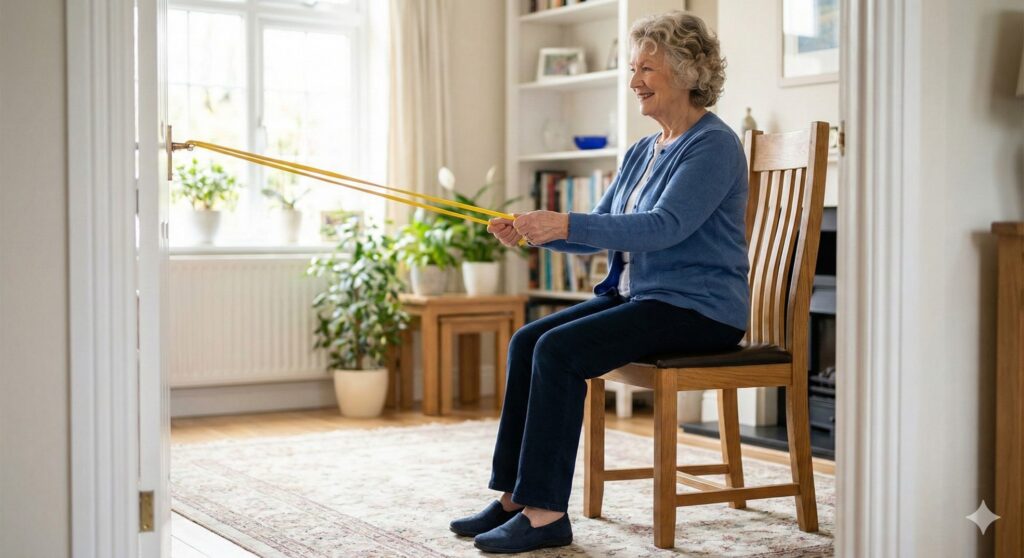
- Sit tall in your sturdy chair with your feet flat on the floor. Scoot forward slightly so your back isn’t resting against the chair.
- Extend your legs out straight in front of you, with your heels on the floor.
- Wrap the center of the band around the soles of your feet (shoes on!).
- Hold one handle in each hand with your palms facing each other.
- Pull your elbows straight back past your ribs, squeezing your shoulder blades together like you are trying to hold a pencil between them.
- Slowly return your arms to the starting position.
Common Mistake to Avoid:
Don’t shrug your shoulders. Keep your shoulders relaxed and down, away from your ears, as you pull back.
Affiliate Link Integration:
For this exercise, a light resistance band set like TheraBand Silver (Extra Light) is excellent because it offers gentle tension that won’t strain your neck.
2. Seated Leg Press for Knee Strength
Purpose/Benefit:
This is a powerhouse move for your legs. It mimics the motion of standing up. Strengthening your quadriceps (thigh muscles) is vital for protecting your knees and ensuring you can get out of a chair or off the toilet independently.
Equipment Needed:
Light to Medium Resistance Band.
Step-by-Step Instructions:
- Sit comfortably in your chair.
- Hold both handles of the band close to your chest.
- Place the center of the band under the arch of your right foot.
- Lift your right foot slightly off the floor, bringing your knee toward your chest.
- Press your foot forward and down, straightening your leg fully against the resistance of the band.
- Slowly bend your knee to return to the starting position.
- Complete your reps on one leg before switching to the other.
Common Mistake to Avoid:
Don’t let the band snap back. Control the return movement. If you let your leg fly back too fast, you risk injuring your hip or knee.

Affiliate Link Integration:
To do this safely, you need a comfortable place to sit. A sturdy dining chair or a specialized seat like Sturdy Dining Chair ensures you won’t tip over while pressing.
3. Banded Glute Bridge for Hip Strength
Purpose/Benefit:
This is a safe way to perform balance training for seniors without standing up. Strong glutes (hip muscles) are essential for walking stability and preventing falls. This exercise can even be done on a firm mattress or the floor.
Equipment Needed:
Loop Band (a circular band without handles).
Step-by-Step Instructions:
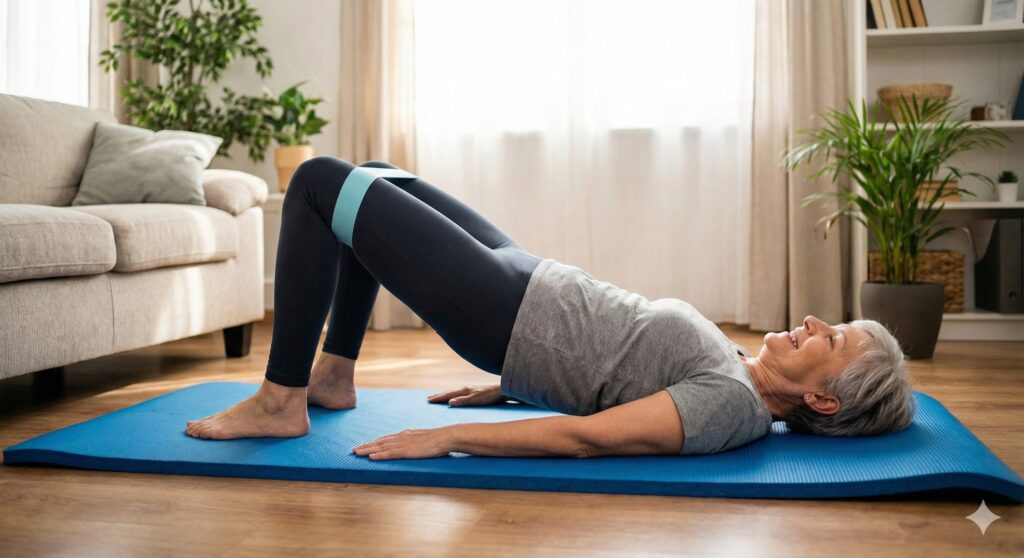
- Lie on your back with your knees bent and feet flat on the floor (or bed), hip-width apart.
- Place the loop band around your thighs, just above your knees.
- Press your feet into the surface and lift your hips toward the ceiling until your body forms a straight line from knees to shoulders.
- As you lift, gently press your knees outward against the band to activate your hips.
- Pause for a count of two at the top.
- Slowly lower your hips back down.
Common Mistake to Avoid:
Don’t arch your lower back. Keep your core tight and lift with your hips, not your spine.
Affiliate Link Integration:
Loop bands are easier for this move than handled bands. We recommend soft fabric bands like Fit Simplify Loop Bands because they don’t roll up or pinch the skin. For more on joint safety, see our Resistance Band Safety Guide.
4. Overhead Press for Shoulder Mobility
Purpose/Benefit:
Reaching for a high shelf requires shoulder strength and mobility. This exercise helps you maintain the ability to lift items overhead safely.
Equipment Needed:
Very Light Resistance Band or Loop Band.
Step-by-Step Instructions:
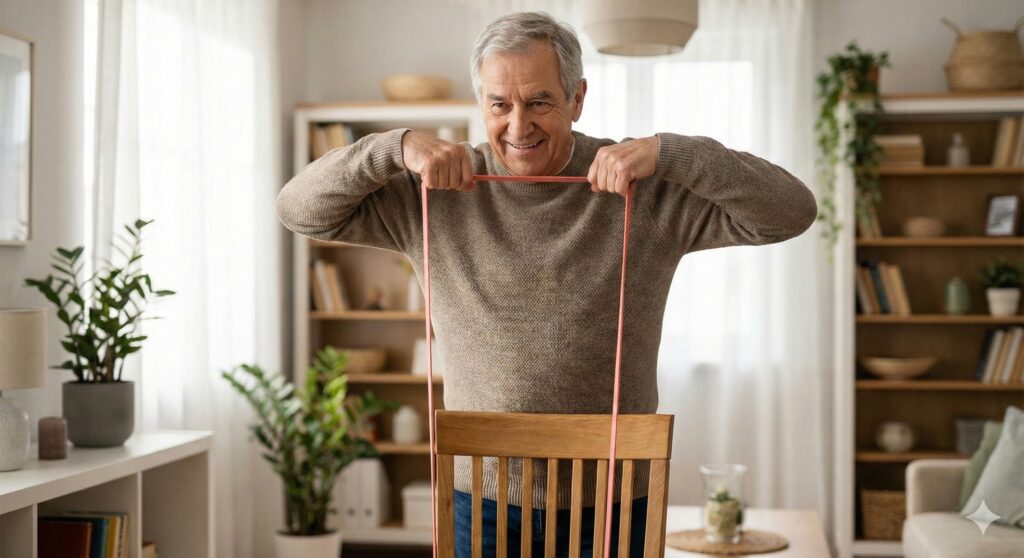
- Sit upright in your chair.
- Sit on the center of the band (anchoring it under your buttocks), holding a handle in each hand at shoulder height.
- Palms should face forward.
- Press one arm straight up toward the ceiling until your elbow is extended (but not locked).
- Slowly lower the hand back to shoulder height.
- Repeat with the other arm, or do both together if you feel stable.
Common Mistake to Avoid:
Don’t lean back. If you have to lean backward to push the band up, the resistance is too heavy. Switch to a lighter band.
Affiliate Link Integration:
If you have sensitive hands, look for bands with padded foam handles like Specific Band Set with Foam Handles to make gripping easier during overhead movements.
5. Bicep Curl for Arm Strength
Purpose/Benefit:
Strong arms aren’t just for bodybuilders. You use your biceps every time you pick up a laundry basket, carry a grocery bag, or hold a grandchild. This is a classic move for arthritis exercises because it strengthens the muscles supporting the elbow without heavy weight.
Equipment Needed:
Light Resistance Band.
Step-by-Step Instructions:
- Sit in your chair or stand with feet shoulder-width apart.
- Place the center of the band under your feet to anchor it.
- Hold a handle in each hand with your palms facing forward and arms hanging down by your sides.
- Keep your elbows tucked into your ribs (imagine you have superglue on your elbows!).
- Curl your hands up toward your shoulders.
- Slowly lower your hands back down.
Common Mistake to Avoid:
Don’t swing your body. Use only your arms to lift the band. If you are rocking back and forth, the band is too strong.

Affiliate Link Integration:
For standing exercises, ensure you have non-slip footwear. A good pair of indoor grip socks or shoes like Senior Safe Footwear]can prevent slipping while anchoring the band.
“Your First Week” Sample Routine
Consistency is far more important than intensity. You do not need to exercise every day to see results. Muscles need rest to repair and grow stronger.
Here is a gentle schedule for your first week:
| Day | Routine Focus | Sets & Reps |
|---|---|---|
| Monday | Full Body Strength | 1 Set of 8-10 repetitions for each of the 5 exercises. |
| Tuesday | Active Rest | Go for a light walk or do gentle stretching. No bands today. |
| Wednesday | Full Body Strength | 2 Sets of 8-10 repetitions for each exercise. Rest 2 mins between sets. |
| Thursday | Active Rest | Light gardening, walking, or rest. |
| Friday | Full Body Strength | 2 Sets of 10-12 repetitions. Try to move a little slower for control. |
| Weekend | Rest & Recovery | Relax and enjoy your weekend! |
FAQ: Common Concerns Answered
What if I have severe arthritis?
Movement is often “lotion for the motion,” helping to lubricate stiff joints. However, during a flare-up (when joints are hot, swollen, or red), it is best to rest. When you are not in a flare-up, resistance bands are excellent for arthritis exercises because they don’t put heavy compression on the joints.
Can I do this if I’ve had a hip or knee replacement?
Generally, yes, but you must adhere to your surgeon’s specific precautions. For example, some hip replacements have restrictions on crossing your legs or bending past 90 degrees. Show these exercises to your physical therapist to confirm they are safe for your specific implant.
How do I know if a band is too heavy?
You should be able to complete 8 to 10 repetitions with good form. If you can only do 3 reps before your muscles shake or your form breaks, the band is too heavy. If you can do 20 reps easily without feeling tired, it is too light.
Where is the safest place to buy good bands?
You can find bands at sporting goods stores, but online retailers often have the best selection for seniors. We recommend looking for sets that include a “door anchor” and clear instructions. Amazon is a convenient option with reliable delivery.Best Selling Resistance Bands on Amazon
Conclusion: Start Small, Celebrate Big
You now have the tools to build a stronger, more resilient body right from your living room. By practicing these resistance band exercises for seniors, you aren’t just building muscle—you are building the confidence to live life on your terms.
Remember, the goal isn’t to look like a bodybuilder. The goal is to feel steady when you walk to the mailbox, to feel strong when you stand up from the sofa, and to enjoy your days with less pain.
Start with the seated row or the bicep curl today. Do just five repetitions. That is a victory! Listen to your body, be kind to yourself, and celebrate every bit of progress you make.
Disclaimer: This content is for informational purposes only and does not substitute for professional medical advice. Always consult your healthcare provider before beginning any new exercise program.
Read our Disclaimer | Privacy Policy | Contact Us