
Lower back pain affects 8 out of 10 people at some point in their lives, making it one of the most common reasons for missed workdays and doctor visits. If you’re reading this, you’re likely all too familiar with the debilitating ache, stiffness, and frustration that come with it. The good news is that you can build a stronger, more resilient back from the comfort of your home.
As a physical therapist specializing in spinal rehabilitation, I’ve seen firsthand what works and what doesn’t. While heavy lifting has its place, it can often exacerbate lower back issues. This is where resistance bands become an indispensable tool. They are uniquely suited for lumbar rehab for three key reasons:
- Reduced Spinal Compression: Unlike dumbbells or barbells, bands don’t rely on gravity. This means you can strengthen your muscles without adding stressful downward pressure on your spinal discs.
- Accommodating Resistance: The tension increases as you stretch the band. This challenges your muscles most when they are at their strongest point in the movement, promoting safe and effective strength gains.
- Multi-Planar Training: Bands allow you to move in all directions—forward, backward, side-to-side, and rotationally. This is crucial for training the small, deep core stabilizers that protect your spine during everyday life.
This is not just a list of exercises. It’s a progressive 4-week routine designed to build a pain-resilient back, providing both immediate relief and long-term strength.
Disclosure: As an Amazon Associate I earn from qualifying purchases. This post contains affiliate links.
Critical Safety First Section (MUST READ)
Your safety is the top priority. While this routine is designed to be safe and effective, it’s essential to recognize when you need professional medical advice.
STOP – See a Doctor or Physical Therapist First If You Experience:
- Pain that radiates down one or both legs, especially past the knee.
- Numbness, tingling, or weakness in your legs or feet.
- Loss of bowel or bladder control (this is a medical emergency).
- Back pain that resulted from a recent significant trauma, like a fall or car accident.
- Pain that is constant, severe, and doesn’t change with your position or activity.
It’s also vital to understand the difference between muscle fatigue and joint pain.
- “Good Pain” (Muscle Discomfort): A feeling of burning or fatigue in the target muscles. This is a sign that your muscles are working and getting stronger. It should subside shortly after you stop the exercise.
- “Bad Pain” (Joint/Nerve Pain): Sharp, stabbing, or shooting pain in your lower back or radiating down your leg. If you feel this, stop the exercise immediately. It’s a signal that you are irritating a sensitive structure.
For this routine, you only need a few simple pieces of equipment:
- A set of light-to-medium loop bands Fit Simplify Loop Bands.
- A comfortable exercise mat Extra-thick Exercise Mat.
The 4-Phase Rehabilitation Protocol
This protocol is your roadmap to physical therapy for back pain at home. We will progress week by week, building a solid foundation before moving to more challenging movements. Listen to your body and never push through sharp pain.
Phase 1 (Week 1): Mobility & Activation
Goal: To gently restore movement to the lumbar spine and wake up the deep core and glute muscles that support it.
Frequency: 4-5 days this week.
Sets/Reps: 2 sets of 10-15 repetitions for each exercise.
Exercise 1: Cat-Cow with Band Feedback
- Target Muscles: Erector Spinae, Abdominals, Multifidus.
- Why it helps back pain: This classic mobility drill gently flexes and extends the spine. The band provides feedback to help you engage your core rather than just hang from your lower back.
- Step-by-Step Instructions:
- Start on all fours with your hands under your shoulders and knees under your hips.
- Place a light loop band around your mid-back, holding the ends under your palms.
- Cow: Inhale as you drop your belly toward the floor, lifting your chest and tailbone. You should feel the band get tighter.
- Cat: Exhale as you press into your hands, rounding your spine up toward the ceiling and pushing against the band. Tuck your chin to your chest.
- Move slowly and deliberately between the two positions.
- Common Mistake to Avoid: Moving too quickly or forcing the range of motion. The goal is gentle movement, not a deep stretch.
- Visual Aid Suggestion: Imagine your spine moving one vertebra at a time, like a wave.
Exercise 2: Dead Bug with Band Resistance
- Target Muscles: Transverse Abdominis (your deep core corset), Pelvic Floor.
- Why it helps back pain: It teaches your core to stabilize your pelvis and spine while your limbs are moving—a fundamental skill for preventing back pain.
- Step-by-Step Instructions:
- Lie on your back with your knees bent and feet flat. Place a light loop band around the arches of your feet.
- Lift your legs into a “tabletop” position (knees over hips, shins parallel to the floor). Press your lower back gently into the mat.
- Engage your core. Exhale as you slowly extend one leg straight out, pushing against the band’s resistance.
- Go only as low as you can without letting your lower back arch off the floor.
- Inhale as you slowly return to the tabletop position. Repeat with the other leg.
- Common Mistake to Avoid: Letting your lower back arch. If it does, reduce your range of motion or use a lighter band.
- Visual Aid Suggestion: Imagine pulling your belly button down towards your spine to keep your core tight.
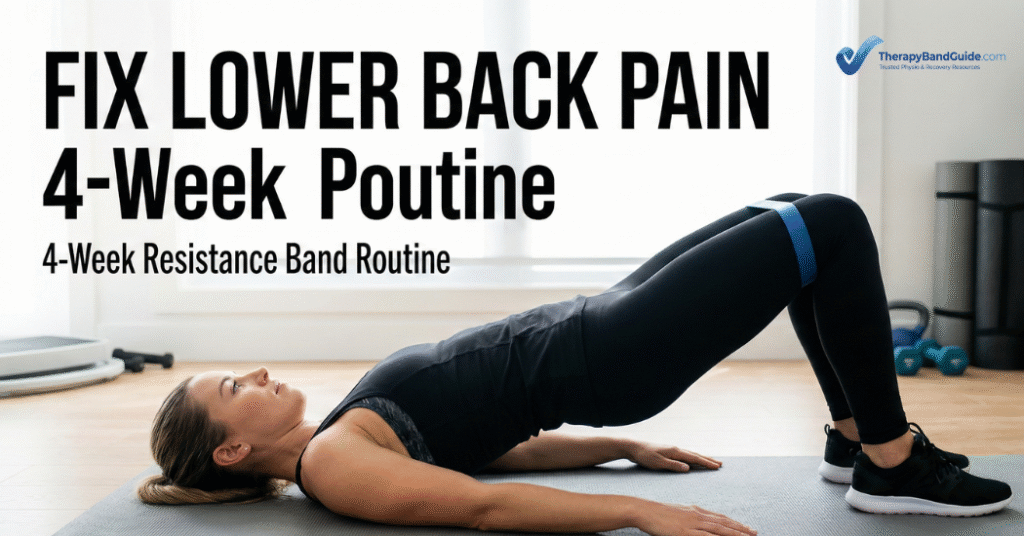
Exercise 3: Glute Bridge with Mini-Band
- Target Muscles: Gluteus Maximus, Hamstrings.
- Why it helps with back pain: Strong glutes take significant pressure off the lower back. This exercise activates them without straining the spine.
- Step-by-Step Instructions:
- Lie on your back with knees bent, feet flat on the floor, and arms by your sides. Place a loop band around your thighs, just above your knees.
- Keep your feet hip-width apart and apply light outward pressure on the band to activate your outer glutes.
- Exhale as you squeeze your glutes and lift your hips off the floor until your body forms a straight line from your shoulders to your knees.
- Hold for 2 seconds at the top, squeezing your glutes hard.
- Inhale as you slowly lower your hips back down.
- Common Mistake to Avoid: Overarching the back at the top. The work should come from your glutes, not your spine.
- Visual Aid Suggestion: Imagine you are holding a hundred-dollar bill between your butt cheeks—don’t let it drop!
Phase 2 (Weeks 2-3): Core Stability & Control
Goal: To build endurance in the muscles that prevent unwanted movement in the spine.
Frequency: 3-4 days per week.
Sets/Reps: 3 sets of 10-12 repetitions per side.
Exercise 1: Banded Bird-Dog
- Target Muscles: Multifidus, Erector Spinae, Glutes, Transverse Abdominis.
- Why it helps back pain: A powerhouse for spinal stability, this exercise challenges your core to prevent rotation and extension while coordinating opposite limbs.
- Step-by-Step Instructions:
- Start on all fours. Place a light loop band around the arch of your right foot and hold the other end in your left hand.
- Brace your core. Exhale as you simultaneously extend your right leg straight back and your left arm straight forward.
- Keep your back flat and your hips level. Imagine you have a glass of water on your lower back.
- Hold for 2-3 seconds, then slowly return to the start. Complete all reps on one side before switching.
- Common Mistake to Avoid: Rotating the hips or arching the back to lift the leg higher. Height doesn’t matter; stability does.
- Visual Aid Suggestion: Think of reaching long through your heel and fingertips to create a straight line.
Exercise 2: Pallof Press (Anti-Rotation)
- Target Muscles: Obliques, Transverse Abdominis.
- Why it helps back pain: This exercise trains your core to resist rotational forces, which is crucial for protecting your back when twisting or lifting. It’s one of the best exercises for strengthening your core to help with back pain.
- Step-by-Step Instructions:
- Loop a long resistance band around a sturdy anchor point at chest height.
- Stand sideways to the anchor, holding the band with both hands at your chest. Step away from the anchor to create tension.
- With feet shoulder-width apart and knees slightly bent, brace your core.
- Exhale as you press the band straight out in front of you. The band will try to pull you back toward the anchor; your job is to resist.
- Hold for 3 seconds, then slowly bring your hands back to your chest.
- Common Mistake to Avoid: Letting your torso rotate or your hips shift. Stay rigid and square.
- Visual Aid Suggestion: Imagine your torso is encased in concrete from your shoulders to your hips.
Exercise 3: Standing Banded Clamshell
- Target Muscles: Gluteus Medius.
- Why it helps back pain: A weak gluteus medius can cause the pelvis to drop during walking, placing stress on the lower back. This strengthens that key hip stabilizer.
- Step-by-Step Instructions:
- Place a loop band around your thighs, just above the knees.
- Stand with your feet together, holding onto a wall or chair for balance. Adopt a mini-squat position.
- Keeping your feet together and torso upright, exhale as you drive one knee out to the side against the band.
- Focus on squeezing the outer glute of the moving leg.
- Slowly return to the starting position. Complete all reps on one side before switching.
- Common Mistake to Avoid: Leaning your torso to help lift the leg. The movement should only come from the hip.
Phase 3 (Week 4): Integrated Strength
Goal: To apply your newfound stability to functional movements that mimic daily life.
Frequency: 2-3 days per week.
Sets/Reps: 3 sets of 8-12 repetitions.
Exercise 1: Banded Romanian Deadlifts (RDLs)
- Target Muscles: Glutes, Hamstrings, Erector Spinae (isometrically).
- Why it helps back pain: This teaches the proper hip-hinge pattern for lifting objects off the floor, using your legs and glutes instead of your back. It’s an excellent exercise for lower back pain relief when done correctly.
- Step-by-Step Instructions:
- Stand on a long resistance band with both feet, hip-width apart. Hold the ends of the band in each hand.
- Keep a slight bend in your knees and maintain a flat back.
- Initiate the movement by pushing your hips straight back, as if trying to touch a wall behind you.
- Lower your torso until you feel a good stretch in your hamstrings, keeping the band taut.
- Exhale, squeeze your glutes, and drive your hips forward to return to a standing position.
- Common Mistake to Avoid: Rounding the lower back. Keep your chest up and your spine neutral throughout.
- Visual Aid Suggestion: Imagine your hips are a drawer you are pushing shut behind you.
Exercise 2: Seated Row to Chest
- Target Muscles: Latissimus Dorsi, Rhomboids, Biceps.
- Why it helps with back pain: Strong back muscles provide support for your spine. This is a safe way to build upper back strength without loading the lumbar area.
- Step-by-Step Instructions:
- Sit on the floor with your legs extended. Loop a band around your feet and hold the ends.
- Sit up tall with a neutral spine. If you have tight hamstrings, bend your knees slightly.
- Squeeze your shoulder blades together and pull the band toward your lower chest.
- Keep your elbows tucked in close to your body.
- Hold the contraction for a second, then slowly extend your arms back to the start.
- Common Mistake to Avoid: Slouching or using momentum to pull the band. Stay tall and control the movement.
- Visual Aid Suggestion: Imagine you are trying to squeeze a pencil between your shoulder blades.
Exercise 3: Band-Resisted Side Plank
- Target Muscles: Obliques, Gluteus Medius, Quadratus Lumborum (QL).
- Why it helps with back pain: This advanced exercise builds lateral core strength, which is vital for pelvic stability and the prevention of side-bending injuries.
- Step-by-Step Instructions:
- Place a loop band around your thighs. Lie on your side, propped up on your forearm with your elbow directly under your shoulder. Knees can be bent (easier) or straight (harder).
- Lift your hips off the floor, keeping your body in a straight line from head to toe.
- Once stable, lift your top leg against the band’s resistance, keeping your core tight.
- Hold the top position for 2-3 seconds before slowly lowering the leg. Maintain the side plank throughout.
- Common Mistake to Avoid: Letting your hips sag toward the floor. Keep them pushed up and forward.
- Visual Aid Suggestion: Imagine you are being pulled up toward the ceiling by a string attached to your top hip.
Phase 4 (Ongoing): Maintenance & Prevention
Once you have completed the 4-week protocol, you don’t stop. You now have a toolkit for long-term back health. Integrate these exercises into your regular routine. A great maintenance plan is to perform a full-body routine 2-3 times per week, choosing 2-3 of your favorite exercises from this guide for each session. This is an effective office back pain routine you can do after work.
The Essential Equipment Guide
Investing in the right equipment can improve your consistency and results. Understanding resistance levels is key; you can read our guide [LINK: How to Choose Resistance Level] for more details. For a full breakdown, check out our review of the [LINK: Best Resistance Bands].
| Kit Type | Components | Pros |
| Budget Starter Kit | Fit Simplify Loop Bands + Basic Mat | Inexpensive, great for beginners, provides everything you need to start. |
| Professional-Grade Kit | TheraBand Set CLX Loops + Pro Mat + Door Anchor | More durable, offers more resistance options, door anchor allows for more exercises like rows and Pallof presses. |
Investing in quality bands matters. Cheaper bands can snap or lose elasticity quickly, while higher-quality ones provide more consistent tension and last longer, making your workout safer and more effective.
Frequently Asked Questions (FAQ)
“How soon will I feel relief?”
Many people experience decreased stiffness and increased mobility within the first week (Phase 1). Significant strength gains and pain reduction often become more noticeable in weeks 3 and 4. Consistency is the most important factor.
“Can I do this if I have a herniated disc?”
You must consult your doctor or physical therapist first. That said, gentle, non-compressive exercises like the ones in Phase 1 (Dead Bug, Glute Bridge) are often a core part of herniated disc rehabilitation protocols because they stabilize the spine without loading it. Avoid any movement that causes sharp or radiating pain.
“Is it normal to feel sore?”
Yes, it is normal to feel muscle soreness (Delayed Onset Muscle Soreness or DOMS) 24-48 hours after exercising, especially when you are starting. This is the “good pain” we discussed. It should feel like a dull ache in the muscles you worked, not a sharp pain in your back joint.
“What time of day is best to exercise?”
The best time is whenever you can do it consistently. Some people find that gentle mobility in the morning helps with stiffness. Others prefer to do their strength work in the afternoon or evening, when their bodies are more warmed up.
Conclusion & Empowerment
You have now completed your masterclass on using resistance bands for lower back pain. You have a plan, the exercises, and the knowledge to take control of your back health. Remember that consistency beats intensity every time. It is far better to do 15 minutes of controlled, pain-free exercise five days a week than to do one grueling hour that leaves you in pain.
Consider keeping a simple exercise log to track your progress. Note the exercises you did, the reps, and how you felt. This will keep you motivated and help you see how far you’ve come. You are not defined by your back pain. By committing to this routine, you are building a stronger foundation for a more active, pain-free life.
Read our Disclaimer | Privacy Policy | Contact Us