
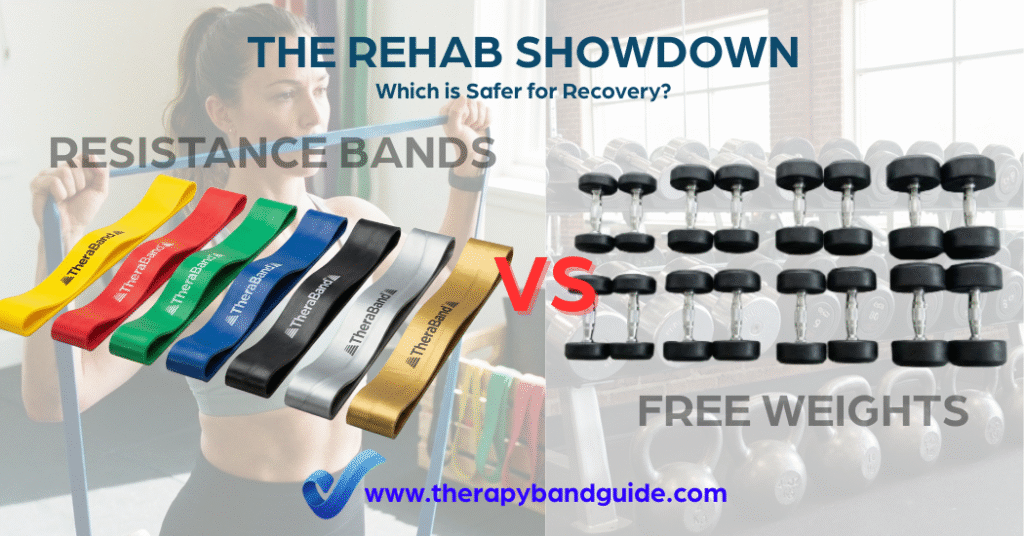
You’ve just left the physical therapist’s office, a handful of papers with exercises clutched in your hand. Whether you’re recovering from knee surgery, managing chronic back pain, or working through a stubborn shoulder impingement, the instruction is clear: get stronger. Now you stand at a crossroads, faced with a critical decision for your home rehab: Should you invest in a set of dumbbells or a pack of resistance bands? This debate between resistance bands and free weights is common, and choosing the right home rehab tools can make all the difference in your recovery.
The goal of this guide is to give you a clear, evidence-based comparison from a physical therapy perspective. We will break down the pros and cons of each, explore why one is often superior for recovery, and show you how to build a smart, effective toolkit for your specific needs. By the end, you will be able to confidently select the right physical therapy equipment to get you back to feeling strong, mobile, and pain-free.
Disclosure: As an Amazon Associate I earn from qualifying purchases. This post contains affiliate links.
Head-to-Head Comparison: Bands vs. Weights
To understand the core differences, let’s start with a direct comparison across the factors that matter most for rehabilitation.
| Joint Safety & Injury Risk | Lower risk. Accommodating resistance is less stressful on joints at the start of a movement. No risk from dropping. | Higher risk. Constant load can stress vulnerable joints. High risk of injury if dropped. |
| Variable vs. Fixed Resistance | Variable (“Accommodating”) resistance. Tension increases as you stretch the band, matching the muscle’s strength curve. | Fixed resistance. A 10 lb dumbbell weighs 10 lbs through the entire motion. |
| Exercise Versatility & Range of Motion | Extremely high. Allows for rotational, diagonal, and multi-planar movements. | Moderate. Primarily works against gravity in a vertical plane. |
| Portability & Space | Excellent. Lightweight, fits in a small bag. Requires minimal space to use. | Poor. Heavy, bulky, and requires significant storage space, especially for a full set. |
| Cost & Setup | Low. A full set often costs less than a single pair of dumbbells. No setup required. | High. Building a versatile collection can be very expensive. Requires dedicated space. |
| Progression Tracking | More difficult. Resistance varies by stretch length, making precise tracking challenging. | Easy. Progression is clear and measurable (e.g., moving from 10 lbs to 15 lbs). |
| Best Use Cases | Early-to-mid stage rehab, joint mobility, functional training, activation exercises, travel workouts. | Late-stage rehab, building maximal strength, increasing bone density, power development. |
Why Bands Are Superior for Most Rehab Scenarios
When you look at the table, a clear pattern emerges. For the majority of people navigating the sensitive stages of physical therapy, resistance bands offer a safer and more functional path to recovery. Let’s explore why.
Accommodating Resistance: Your Joint’s Best Friend
The single most important feature of resistance bands is their ability to accommodate resistance. This means the tension increases as you move through the range of motion. Think of a bicep curl: with a dumbbell, the load is heaviest at the beginning of the curl when your arm is most extended, and your joint is most vulnerable. In a band, resistance is lightest at the start and peaks at the top of the movement, where your muscles are strongest.
This variable tension perfectly matches your body’s natural strength curve, applying less force when your joints are at a mechanical disadvantage and more force when they are strongest. This makes bands an incredibly joint-friendly exercise tool, reducing the risk of re-injury and allowing you to strengthen muscles without aggravating sensitive tissues. As we detail in our guide on [LINK to How to Choose Resistance Level], selecting the right band tension is crucial for maximizing this benefit.
Lower Compressive Forces
Free weights, by their nature, work directly with gravity. This creates downward compressive forces that can be problematic for certain injuries. Performing a squat with a heavy barbell places a significant compressive load on the spine. Likewise, an overhead dumbbell press can compress the shoulder joint.
Bands, however, generate resistance in the direction they are stretched, not necessarily downward. This allows you to perform strengthening exercises with minimal joint compression. For someone with lower back pain or shoulder impingement, this is a game-changer. You can strengthen the supporting muscles without placing a direct, heavy load on the injured area itself.
Functional Movement Patterns for Real Life
Injuries rarely happen in a single, isolated plane of motion. We hurt ourselves twisting to lift a box, reaching diagonally to grab something, or rotating to catch our balance. To build resilience, our rehabilitation must mirror these real-world demands.
This is where bands truly shine. Unlike free weights, which are largely limited to up-and-down movements, bands can be anchored from any angle—high, low, or to the side. This allows you to train in multiple planes of motion simultaneously. You can perform rotational core exercises (wood chops), diagonal shoulder patterns (D2 flexion), and hip movements that directly translate to better walking, lifting, and balancing in your daily life.
Unmatched Safety and Accessibility
Let’s be blunt: you can’t drop a resistance band on your foot. There’s no risk of getting pinned under a heavy weight. This inherent safety removes a major psychological barrier for many people who are hesitant to exercise after an injury. The lower risk profile makes bands the ideal tool for building a home gym on a budget and getting started with a new program.
For a versatile and reliable option, a multi-pack like the Fit Simplify 5-Pack offers a great starting point with various tension levels. For those seeking professional quality, the TheraBand Professional Set is the gold standard used in clinics worldwide.
When Free Weights Still Have a Place
While bands are the superior choice for most rehab situations, free weights are not without merit. They play a crucial role in the later stages of recovery and for specific fitness goals.
Building Absolute Strength and Bone Density
For developing raw, maximal strength, nothing beats free weights. The fixed, measurable load of a dumbbell or barbell provides a clear and powerful stimulus for muscle hypertrophy (growth). Furthermore, heavy, weight-bearing exercises are scientifically proven to be the most effective way to increase bone mineral density, which is critical for staving off osteoporosis. Once you are cleared by your therapist for heavier loading, integrating weights is key for building a truly robust and resilient body.
Greater Stability Demands
Balancing a dumbbell requires your body to recruit a host of small stabilizer muscles around the primary joint. A dumbbell bench press, for example, engages more stabilizing muscles in the shoulder than a banded chest press, where the tension is more controlled. This can be beneficial in the later stages of rehab, as it challenges your neuromuscular control and prepares the joint for unpredictable real-world forces. As we’ve covered in our [LINK to Shoulder Guide], progressing to this stage must be done carefully.
Best for Specific Power-Based Goals
If your goal is to return to advanced athletics, powerlifting, or CrossFit, free weights are non-negotiable. The explosive power required for movements like kettlebell swings or Olympic lifts cannot be replicated with bands. Free weights are the tool for top-end performance goals.
The Honest Drawbacks
It’s important to be realistic about the downsides of free weights, especially for home use. They are expensive, require significant storage space, and carry a much higher risk of acute injury if used with poor form or dropped. The static resistance can also be jarring on sensitive joints, making them a poor choice for the initial phases of recovery.
The Hybrid Approach: The Smartest Choice for Long-Term Fitness
The debate of resistance bands vs. free weights often misses the most important point: you don’t have to choose. The most effective long-term strategy for health and fitness involves using both tools intelligently. By combining the joint-friendly mobility work of bands with the strength-building power of weights, you get the best of both worlds.
Here is a sample weekly schedule for someone in the mid-to-late stage of recovery:
- Monday (Band Day): Mobility & Activation
- Focus on higher repetitions (15-20 reps) with lighter bands.
- Exercises: Banded pull-aparts for shoulder health, clamshells for glute activation, monster walks for hip stability, and torso rotations for core control.
- Goal: Improve joint mobility, warm up connective tissues, and activate key stabilizer muscles.
- Wednesday (Weight Day): Foundational Strength
- Focus on controlled, compound movements with light-to-moderate dumbbells.
- Exercises: Goblet squats, Romanian deadlifts, dumbbell bench press, and bent-over rows.
- Goal: Build foundational strength in major muscle groups with a focus on perfect form.
- Friday (Hybrid Day): Power & Function
- Use bands for activation, then follow with a weighted exercise.
- Example: Perform 3 sets of banded glute bridges to “wake up” your glutes, then perform your weighted goblet squats. You’ll feel a stronger, more stable connection.
- Another example: Use a light band around your knees during a dumbbell squat to force your hip abductors to work harder, correcting knee valgus (caving inward).
A fantastic starter kit for this hybrid approach would be a set of Bowflex SelectTech Adjustable Dumbbells paired with a versatile TheraBand CLX Loop Set, giving you a complete home gym for every stage of your journey.
Product Recommendations for Your Home Rehab Kit
To simplify your choice, here are three curated kits for different needs and budgets:
- Best Budget Rehab Starter Kit: For under $50, you can get everything you need to start.
- Kit: Fit Simplify Resistance Loop Bands and a basic door anchor.
- Why: This combination is incredibly versatile, allowing you to perform dozens of upper and lower body exercises safely at home. It’s the perfect entry point.
- Best Professional/Clinic-Grade Kit: If you want the same equipment physical therapists use and are ready to invest in long-term strength.
- Kit: TheraBand Professional Non-Latex Resistance Band Set and a pair of adjustable dumbbells.
- Why: TheraBand is the most trusted name in rehab. Paired with adjustable dumbbells, this kit will take you from the earliest stages of recovery to advanced strength training.
- Best All-in-One Hybrid Solution: For those who want a comprehensive system that integrates both modalities.
- Kit: Specific Amazon Bundle (Note: Look for bundles that include tube bands with handles, loop bands, and a door anchor).
- Why: These pre-made kits often provide the best value and ensure all the components work together seamlessly, giving you a complete hybrid gym in a box.
Conclusion: Your Final Recommendation
So, what’s the final verdict in the resistance bands vs. free weights showdown for physical therapy?
For 80% of people starting a home exercise program for rehabilitation, resistance bands are the smarter, safer, and more effective first investment. Their accommodating resistance, joint-friendly nature, and functional versatility make them the ideal tool for rebuilding strength without risking re-injury. They are affordable, portable, and allow you to train the complex movement patterns you need for a full return to daily life.
Free weights are not the enemy; they are simply a more advanced tool. Think of them as the next chapter in your fitness journey. Once you have built a solid foundation of mobility, stability, and control with bands, integrating free weights becomes a powerful way to develop maximal strength and bone density.
Start with bands. Master your form. Listen to your body. And when you’re ready, embrace the hybrid approach to build a body that is not just recovered, but truly resilient.
Read our Disclaimer | Privacy Policy | Contact Us